
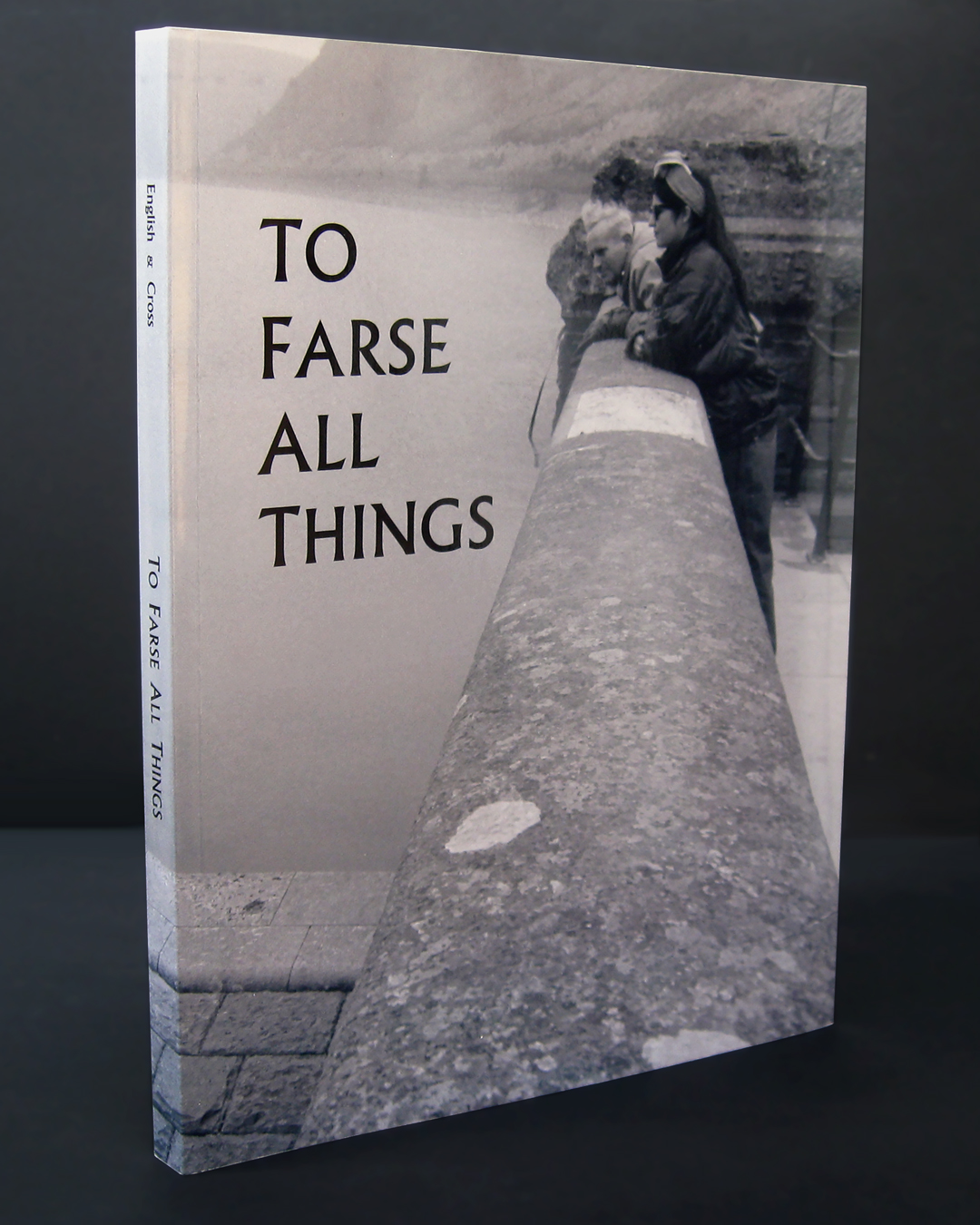
A new book by William English and Sandra Cross will be published this month: ‘To Farse All Things’. Its title means “to mix together”. The book ‘farses’ together art and life, and, much like in cooking, the ingredients that may be awkward to consume on their own, e.g. onion, wasabi, garlic, ginger, cinnamon, etc., are transformed when finely mixed with other foodstuffs. I was the graphic designer, and was also invited to supply a decidedly farsed foreword where I ply my trademark plaint of the ‘thwarted history’, even though the book itself owes its existence to a victory over thwartedness, as I’ll describe…
Thwarted history restitution is an increasingly personally-felt research initiative of mine. Despite a growing wider interest in obscured histories, I find there’s something akin to an occult principle at work that denies the deepest excavations any re-entry into the cultural continuum. Necessarily, I taught myself book design in anticipation of having to self-publish (if/when funds appear). Bafflingly, my researches – the post-electronic acoustic synthesis textbook, the Victorian electro-musical exposé, the literary outliers project – possess archaeological heft completely at odds with the disinterest that greets them, online or offline. I use the term “thwarted” to hint at an antagonising agency. There’s a sense that it would short-circuit our present timeline to introduce into it hypothetical alternative “thwarted” timelines; the laws of physics forbid it. This my own impression, at least, having banged my head against invisible brick walls over the past decade – rushing from stall to stall at small press bookfairs, giving my sample pamphlets to prospective publishers who only respond: “sorry, but no thank you”. Regarding yesteryear’s scuppered potentials of now-unknown marvels and anachronisms, I keep asking “does obscurity beget obscurity?” and an affirmative dread seems to waft up from the catacombs where the ancient cultural thwarting agencies fester, very much undead, and as flippant as ever.
In view of these challenges when presenting novel material, I crave legibility as a designer, but William urged me to embrace visual ambiguity for this latest project. ‘To Farse All Things’ is something of a Trojan horse, as, under a facade of commodity fetishes and healthy eating resources, the casual reader is shanghaied into a world of unknown wonders – underground filmmakers, private journals, genius inventors, ruminations on discovery and loss, persevering artists and their imperilled ephemera… Household(ish) names such as Vivienne Westwood, Malcolm McLaren, Kenneth Anger, etc. rub shoulders with (among others) inventor Captain Maurice Seddon, Dutch esotericist-restaurateur Nicolaas Kroese, radical entrepreneur Richard Handyside, optician-to-the-stars Tony Gross, and free energy theorist Hugh de la Cruz. It was with Hugh that I was once implicated in an unfulfilled scheme whereby I’d assist with realising his ‘perpetual motion’ machine in return for free lodging at a disused flat he had in Bow, London. William English had introduced us both. Likewise, William and his partner Sandra Cross are the artist-celebrants who are able to interconnect so many disparate characters, often through their groundbreaking 1980s Dining Room restaurant – a literally underground vegetarian venue near Borough Market which became a refuge for those of unconventional spirit. ‘To Farse All Things’ sees worlds collide, too; many geographies are straddled, and in one of the most powerful sections of the book, Sandra Cross’ ‘Limbo’ section impressionistically records back-and-forth trips from urban London to suburban Leicester to visit her mother who had probable Alzheimers. Elsewhere, William’s ‘Film Theory’ gospel follows the ‘ur’ cinema of the prehistoric Miocene all the way up to Jean Cocteau’s French Riviera, via a Dadaist curriculum-vitae of sorts, which luxuriates in a gentle egocentricity in a way only self-published literature allows (and which I champion ferociously, in the paucity of third-party advocates).
Perhaps the rarest thing is to behold, in print, the most detailed record currently available of William English’s and Sandra Cross’ own work, spanning filmmaking and art installation. By the final 20 pages, the build-up of lived experience seems to capsize all formalities – a point of bifurcation heralds the onrush of chaotic variables in the form of a bedtime fiction about a dealer of so-called ‘failed artists’ ephemera, the antiquarians who sweep it up, and various other albatrosses. It has resonance with my “thwarted histories” flailings. It also features a startling visual cameo from the legendary Orlando Harrison in the role of one of William’s imaginary terrors.
The book was made possible by the support of Nottingham’s Bonington Gallery and its director, Tom Godfrey, who had found William English’s previous book ‘Perfect Binding: Made in Leicester’ and saw the potentials within it. ‘Perfect Binding’ was William’s 2019 project – fully self-published – into which I funnelled my design skills to try to make sense of his madcap medley of archival material and non-linear primary source upheavals. ‘Perfect Binding’ was, in some ways, a total asymmetrical counterpoint to a more standard history book published around the same time: ‘Mods: Two City Connection’ by Shaun Knapp. ‘Mods’ and ‘Perfect Binding’ are not comparable beyond their superficial subject matter; whereas Knapp’s pursues a narrative of events, ‘Perfect Binding’ acknowledged the impossibility of doing so, due to faulty remembrance, status-related hubris, and “the anarchy of detail” (which Sandra Cross references in the latest book). At first glance ‘Perfect Binding’ might’ve been mistaken for an expensively-produced self-published local history, but it actually performs the aforementioned feat of interconnecting parallel realities into our current culture, citing a host of half- or fully-submerged creatives and inscrutable ‘rebels’. Despite my assumption that the laws of (meta)physics disallow such convergences between offstream and mainstream, William’s 2019 book led directly to ‘To Farse All Things’ which is also the title of a large exhibition of William and Sandra’s work curated by Tom Godfrey – a long overdue aeration of their eclectic output, now showing at the Bonington Gallery until the 13th December 2025. The secret appears to be in the farsing. The 180-page book is available from the gallery, and at selected bookstores.
 Miraculous Agitations - Daniel R Wilson