Radionics Radio at the Science Museum

On Friday 13th June, a live ResonanceFM programme from the Science Museum marks the launch of the Radionics Radio application.  ‘Radionics Radio – Turning Thought into Frequency’ airs at 3:00pm.

The programme is something of a first, as an actual Delawarr radionics broadcasting instrument will be exhibited in earnest at the Science Museum for the first time (for the duration of the programme).  It will not be plugged in, however, owing to health and safety restrictions.

The programme takes place in the Exponential Horn room where ResonanceFM is currently installed.

More information on radionics and the Radionics Radio project can be read on the Sound and Music blog.

An ‘artificial intelligence’ rustic poet

Hop over to the Miraculous Agitations blog to behold attempts to create an artificial intelligence ‘local poet’ using text analysis procedures and speech synthesis.  The poet robot is based on a very obscure 1990s rustic poet called Bill Cooper.  Cooper’s oeuvre was fed into a word-combination probability analyser (based around a Markov chain), and new rustic emissions were sought.

These experiments were briefly featured, among other feverishly discussed book-related things, on William English’s Wavelength on Friday 6th June.  The ‘Robot Bill Cooper’ text generator has implications for books in general: in theory you could dump a book’s text into a program and have a new text generated in the author’s style…

Robot Bill Cooper

Victorian electro-musical variety hall acts / The Art of Noises in London, 1914

There are two new blog posts over at the Miraculous Agitations blog.  ‘The Wire #364 – and Interestingnesses on the Art of Noises‘ gives a bit of background information to the Futurists’ Art of Noises in London, 1914.  Two important sources are transcribed and downloadable.  The Art of Noises centenary is a good cue to examine other bombastic and groundbreaking music hall antecedents, and this is found in the latest issue of The Wire magazine.

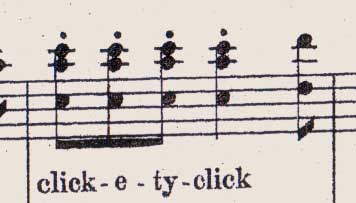
The second post follows up with some information on Clickety-Click (reperformed and hosted here by The Wire) – ‘Clickety-Click – The earliest surviving electrical musical score?‘.  Clickety-Click was an early electro-musical score published circa 1887, unearthed during my research into acoustic novelties of that era.  The recreation was carried out at Resonance 104.4FM by myself, Fari Bradley (piano), Chris Weaver (microphonics) and Toby Clarkson (photographics) – all members of Oscillatorial Binnage as it goes – one of our more unusual and educational productions!

clickety-click-quaver

Resonating street furniture, post-electronic busking and ‘acoustic circuit-bending’

New blog post over at the Miraculous Agitations blog – on resonating street furniture, electromagnetic apparatuses, post-electronic busking and ‘acoustic circuit-bending’.  It forms a sort of cautionary tale on the perils of electromagnetically resonating too far afield.

Also, a primer on post-electronic music can be found in the new Exact Change e-zine #8.

Image

MiraculousAgitations.com

Hello and welcome – this my new base where I’ll collect together various strands of my work.  The previous postings here are all mirrored from the original Miraculous Agitations site.  From here onward, these feeds will diverge and I intend to use the feed on this current site to post news and other miscellany.  The original Miraculous Agitations blog will be continued as before, with emphasis on longwinded ramblings as usual.

The most recent emission over there was a short post titled “Entangled Histories: Digging out Electronic Music’s Roots (or, what’s electronic, and what’s not)” which highlighted what appears to be the first electronic instrument performance in the UK.  An expanded documentation of this particular marvel will be found in my upcoming study on the evolution of acoustic novelties on stage (current publication date unknown, but anticipated for 2015).  More info to follow…

alfred graham 1894

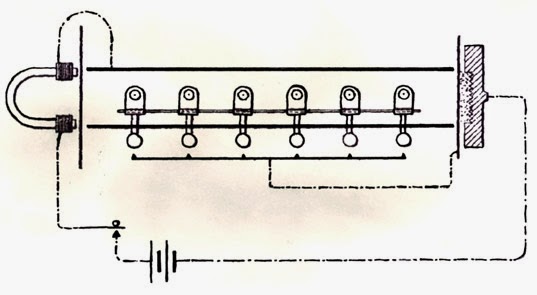
Alfred Graham’s telephonic feedback flute – from his 1894 patent

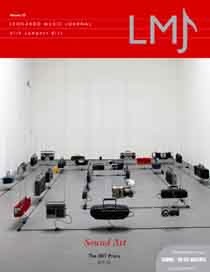
LMJ #23 – "Electric Music" on the Victorian Stage

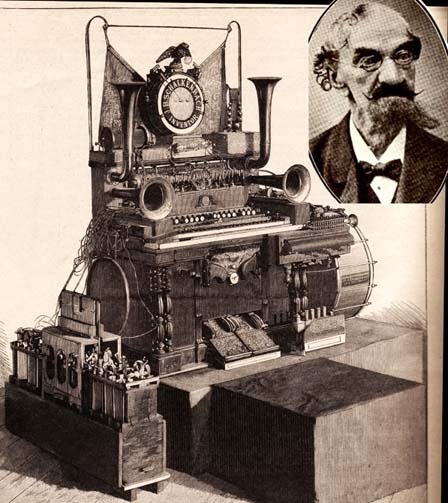
There are many obscure, under-explored sonic marvels to be found in the old music hall annals – I’m rustling to publish a detailed survey soon.  In the meantime, the latest Leonardo Music Journal (#23) features my paper on ‘electrical music’ in Victorian music halls, focussing specifically on the work of the eccentric Johann Baptist Schalkenbach and his imitators.  In the 1860s Schalkenbach developed an act in which he played on an amalgamation of instruments he called the Piano-Orchestre Électro-Moteur (built around a reed harmonium).  Whilst playing, he would simultaneously trigger musical, noise and optical effects via the electromagnetic triggering of circuits connected to objects placed around the hall.  It’s a delicate precursor to the noise machines of the Italian Futurists.  Over the decades, the apparatus gradually became more spectacular as new features were added.

schalk-orchestra2

For some years now I’ve been hunting down ephemera relating to Schalkenbach and his copycats in the hope of shedding some light on the electrical music contraptions.  Precious little information exists, despite Schalkenbach performing for almost 40 years.   LMJ 23’s “‘Electric Music’ on the Victorian Stage: The Forgotten Work of J.B. Schalkenbach” forms the most complete account so far of Schalkenbach’s work.  My research also suggests that in the 1870s Schalkenbach assisted in the construction of acoustic magic tricks for celebrated magicians Maskelyne and Cooke.  Schalkenbach’s conspicuous absence from the “standard” prehistory of electronic music can perhaps be accounted for by the lack of credible information about the electrical aspects of his Piano-Orchestre Électro-Moteur.  Minor gripes rooted in nationalism possibly also contributed to his present obscurity – one early review states that Schalkenbach’s act met with great applause, but: “we fancy it would have gained still greater favour but for [his] singular resemblance to the great German Chancellor Prince Bismarck, which did not quite please some of the audience.”

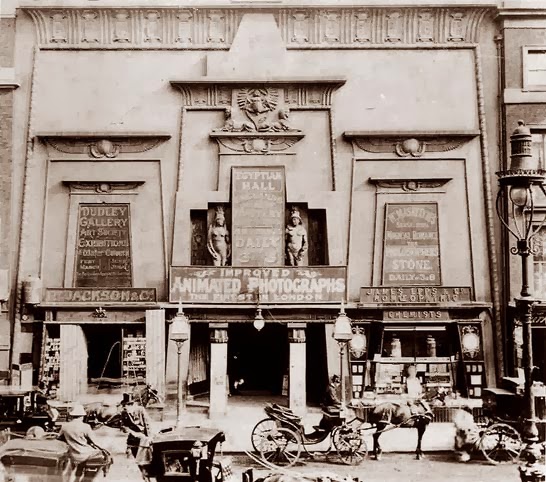
Maskelyne & Cooke’s Egyptian Hall, Piccadilly. (Demolished in 1905)

Schalkenbach played upon the mysteriousness surrounding “electrical music”.  One newspaper reporter presumed that the rain sounds were electrically produced: “in a moment even electricity travels to the roof of the building and also to the apparatus around the hall, and causes vibrations as if a thunderstorm were heard approaching from the distance; you hear the howling of the wind and the downfall of a torrent of rain.”   Investigations reveal that, in reality, the electric action was only employed to control a door, releasing buckshot that rattled down concealed descending shafts (later to become a popular off-stage acoustic rain effect).  But Schalkenbach’s instrument was nevertheless very sophisticated.   In the 1890s, an electrical journal asked, “was it telephonically or phonographically that Herr J. B. Schalkenbach transmitted sounds to a distance?”  It is unlikely that either of these techniques were employed.  It appears to have been primarily electromagnetic triggering (including percussive sounds, motors, release mechanisms, explosives, detonations and light effects), the possibility of trembling-bell style feedback, and the basic wind bellows with their artful acoustic couplings through pipes and funnels.  Although, there are still many mysteries.

The descriptive, noisy, electrically actuated music pioneered by Schalkenbach was subsequently copied by many music hall acts, including Professor Beaumont (aka John Walmsley Beaumont) “Necromancer and Electric Musician”, Herr Renier, and most interestingly, H. F. Juleene (aka John Parsons) and Dot D’Alcorn (aka Susette D’Alcorn), a double act who titled their demonic centrepiece Mephisto.   Dot D’Alcorn is possibly the first professional female performer of an electrical musical instrument.  Juleene and Schalkenbach had an interesting run-in played out in the The Era stage newspaper involving aggressive placement of adverts.

In performance, Schalkenbach played his own music (which does not seem to have survived), and also included selections from operas, such as Daniel Auber’s La muette de Portici‬ and The Storm from Rossini’s William Tell.   Mephisto on the other hand, was more grounded in music hall styles, and some original Juleene compositions do exist.  Dot D’Alcorn would play the electric instrument dressed as Mephistopheles.  I have transcribed the surprisingly twee Mephisto Gavotte (the electrical parts are not scored) – it gives a flavour of the Mephisto repertoire.  It is a MIDI arrangement:

Schalkenbach and his ilk are particularly interesting in relation to the post-electronic music techniques outlined on this blog and elsewhere.  In ‘post-electronics’, acoustic sounds are wrought with close adherence to classical electronic music techniques.  Essentially: acoustics aspiring to electronic sound.  In Schalkenbach’s art, acoustics likewise aspire (or are styled) to ‘electric’ sound despite the utter non-existence of any “electric music” listening paradigms at that time(!).  Schalkenbach produces acoustic sounds – musical and non-musical – distant from the console, and presents them enigmatically as electrically produced sounds – sounds of mysterious provenance: the beginnings of sound art.

More coming soon…

Leonardo Music Journal #23 is out now.

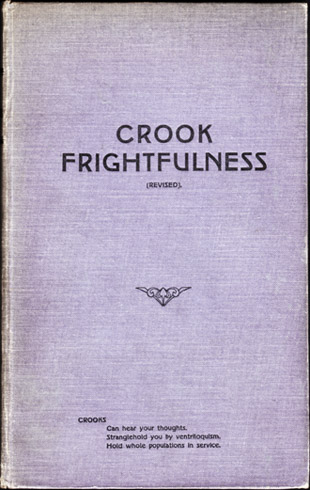
Fortean Times – Sept 2013 – Crook Frightfulness

This month’s Fortean Times #305 (a sort of ‘paranoia special’) features my exposé of the extraordinary anonymously-penned book Crook Frightfulness, self-published in 1935 by “A Victim”.  In this blog post I’ll present some thoughts on the book’s semi-acoustical ideas.

Crook Frightfulness was first brought to my attention by the marvel Westwyrd the Bard: drum-specialist and custodian of curiousness.  For those unacquainted with the book, it’s an autobiography of a man tormented by crooks who embark on a campaign of staring, ventriloquism and covert psychological harassments against the author.  The “Victim” writes of his personal hell in which everybody else is either complicit, or simply fails to notice the ventriloquist abusers who stalk him across the British colonies.  Crooks are also able to hear the Victim’s thoughts by a theorised listening apparatus used with headphones (a sort of powerful stethoscope device).  Some of the antiquated colonial sentiments add an extra dimension of bizarreness.  A colleague described Crook Frightfulness as an “acoustic mystery thriller” although it’s generally seen as a schizophrenic emission.  For anybody interested in sound, its psychology and its perception/misperception, it’s a particularly fascinating book, as the author manages to “attain a degree of impersonal interest” (as he puts it) and proceeds to investigate the phenomena from his own practical, acoustical viewpoint.
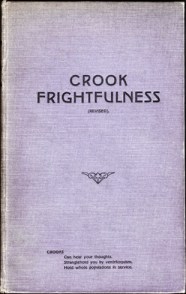
Crook Frightfulness is split into three parts.  The first part – some 40 odd pages – begins almost like a potboiler; autobiographical sensationalism comparable to, say, Sydney Horler’s 1934 exposé, London’s Underworld.  Part two is written more matter-of-factly, albeit disjointedly and with heightened paranoia.  Here, the author writes of his experiences and travels around the colonies to outmanoeuvre the ‘crooks’.  The third part is the ‘Vital Climax’ where the crooks’ terrible practices are examined (involving listening apparatuses).   In FT305, it is suggested that the Victim did experience a genuine low-level persecution that left a lasting resonance.


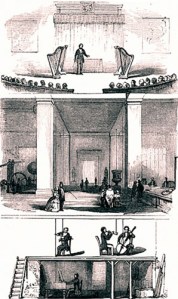
Charles Wheatstone’s ‘Telephonic Concert’ at the Royal Polytechnic Institution

The listening apparatus is hypothesised in general terms.  It is assumed to be able to pick up the minutest sound, akin to an amplifier, functioning in a stethoscope-like arrangement – presumably non-electric.  This acoustic method of sound conveyance conjures to mind Charles Wheatstone’s ideas on acoustic transmission through solids.  Wheatstone coined the term ‘microphone’, not in reference to an electric transducer as we know it now, but to refer to an apparatus where sound is carried by direct transmission through solids to the ear.  In one adaptation of this to sounding bodies, at the Royal Polytechnic Institution in the 1860s Wheatstone exhibited a ‘Telephonic Concert’ – completely non-electric (à la tin-cans-and-string) – where thick wires coupled to musical instruments, played on a concealed lower floor, acoustically carried the sound silently through intermediate floors to a performance stage above, where the wires reconnected with the sounding boards of harps, rediffusing the sound as if by magic.  Wheatstone also visualised the invention of an ideal acoustically conductive material to stretch vast distances, to communicate from Aberdeen to London.   In Crook Frightfulness – ‘A Victim’ presents a visceral horror in which crooks can acoustically subjugate you in this Wheatstonian manner:

“I frequently tried to stifle the annoyance by stopping or closing my ears with my fingers, and when doing so, I rested my elbows on my knees or put my elbows upon the wooden table.  Strange to say, I found that neither of these expedients stopped or banished the sound (…)  The sound when I stopped my ears must have travelled through the wood of the floor and of the table and then through my bones to my ears!  (…)  They no doubt send sounds (by means of some instrument) to molest any intended victim who is in the same premises, or even in adjoining premises.”
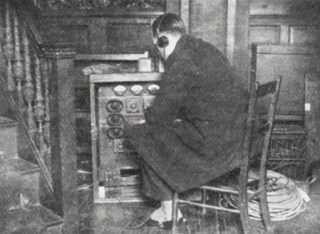
Likewise, crooks are said to “hear your thoughts – the sound travelling through the floor you are standing on (…) to perhaps that next room or adjoining house, to the crook listener”.   Thoughts are heard by closely listening to sub-vocal articulation: “when you think (in 95 cases out of a hundred) you actually shape your words in your throat and mouth.  When we breathe through our mouth or nose it is possible for these fiends to hear your thoughts.”  The Victim’s theories evolve as Crook Frightfulness progresses.  Some later editions feature paste-ins where a “sound ‘outfit’ like the BBC” is theorised.  In spite of the book’s skew-whiff nature, some of these ideas were certainly at the ‘cutting edge’ – an early example of widespread covert listening is seen in the early 1940s with the hidden electric microphones around Trent Park’s prisoner-of-war compound to capture prisoners’ conversations.

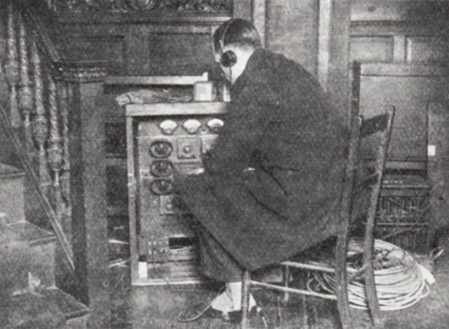
A BBC “sound ‘outfit'” of the period

Last year, the writer and long-time Crook Frightfulness aficionado Phil Baker sold me a first edition of the book.  Baker was also keen to know more about the book’s author.  This spurred me on to compile all the scraps of information I’d collected over the years with a view to building a profile of “Victim”.

The compilation of biographical facts (gleaned from both the first and expanded editions) revealed the author was born in the East End of London, in or around 1875.  He was involved in rent collection and property.  He left Britain for New Zealand in 1924, moved to the British West Indies around 1928, and returned to Britain to settle in Aberystwyth in March 1932.  Many hours at Kew’s National Archives yielded a list of some fifty or so names, gradually whittled down as each name was followed up.  The use of digital archives plays a key role in such research.

It is revealed for the first time in this month’s Fortean Times that Crook Frightfulness was written by an east London estate agent named Arthur Herbert Mills.  He left Britain using the name Herbert Mills, and returned as Arthur Mills, which slightly confused matters, but further research has confirmed the connections.  His story is very interesting, and only a bare outline could be condensed into the article.

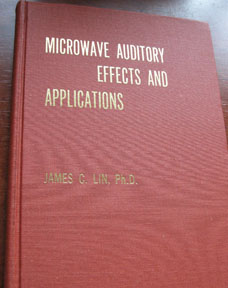
The book presents quite a sad predicament, but it’s hoped that the discovery of the author’s name will enable further study of the text, which charts the onset of auditory disorientation at a point in history where technology could not quite yet provide reasonable objective explanation for the phenomena.  There are a surprising number of narratives very similar to Crook Frightfulness (some early examples are examined in the article).  Today, people with these afflictions/assailments often cite James Lin’s 1978 textbook Microwave Auditory Effects and Applications that superficially appears to corroborate all sonic “unseen assailment” phenomena (although, in practice, such technology is very impractical).
Anyways… It’s not my intention here to delve into the arguments surrounding these phenomena (perhaps in a future posting), it is simply to examine curios and mythologies from acoustical hinterlands.  (It is worth mentioning that a semblance of ‘voices’ can be perceived during exposure to fluctuating white or pink noise for extended periods. This is a psychoacoustic effect: auditory pareidolia.  In one notable example, it is employed in a sound installation by U.S. sound artist Ellen Band in her Acoustic Mirage.)

The full particulars on Crook Frightfulness can be found in Fortean Times #305.

Bookophonics: Making Music with Books

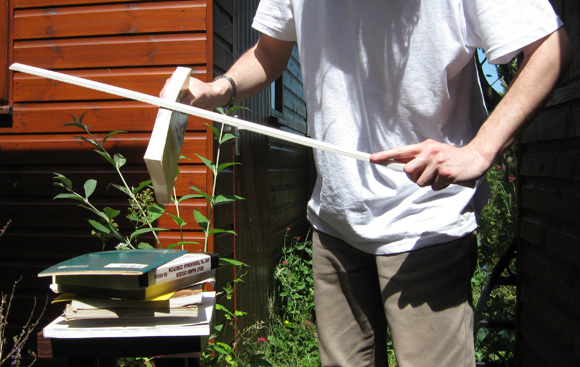
The bookophone is described in an earlier post here.  It involves a paperback book and a bowing rod – preferably some kind of hollow tube, upon which the friction tone is amplified.  The character of the tone derives somewhat from the choice of bowing rod.

Playing bookophones

Last Friday, a short bookophone piece called ‘Summer Song‘ was debuted on William English and Chris Weaver’s Weavelength (part of a series of Wavelength specials touching on cassette culture).  All the sounds in this piece are created by four paperback books overdubbed together: ‘Social Anthropology in Perspective,’ Bird’s ‘Mathematical Formulae,’ ‘Great Mambo Chicken and the Transhuman Condition,’ and ‘Is it Just Me or is Everything Shit?‘.   The books are played with plastic and chrome bows.

It appears that temperature affects the bookophone sound.   Bookophones are generally deeply unplayable things and near-impossible to wrest a melody from, despite weeks of practice.  In the summer season, books are apparently more stubborn than usual in producing tones, demanding a more vigorous action (as heard in this piece).  This is perhaps because there is less discrepancy between the environmental warm temperature and the momentary heat caused by the bow friction(?).  Dryness certainly deadens the tones.  Anyways, it just means that in the summer, when playing the bookophone, you must really ‘give it some welly’.

I can’t seem to find any similar technique employed in making books ‘sing’, but surely over 500 years somebody must’ve tried something similar.  Maybe a romantic poet?   Incidentally, the very clever Maywa Denki laboratory has produced a musical electric book beating apparatus.  (Maywa Denki received exposure in the UK some years ago with a memorable appearance of a self-playing acoustic guitar on BBC One’s Adam and Joe Go Tokyo.)

Wok Music: Music of the Hemispheres

The process of obtaining ‘miraculous agitations’, as I’ve written before, revolves around chance occurrences.  From a purely intuitive standpoint, it’s hard to pin down the catalyst that transforms a vibrating apparatus from a ‘bone-idle-tone’ into inspirational ‘tone-drama’ (that is, the once-in-a-blue-moon complex and inspiring acoustic stuff).  It appears as a chance convergence of microscopic parameters: an imperceptible movement of some element suddenly causing an emergent state…

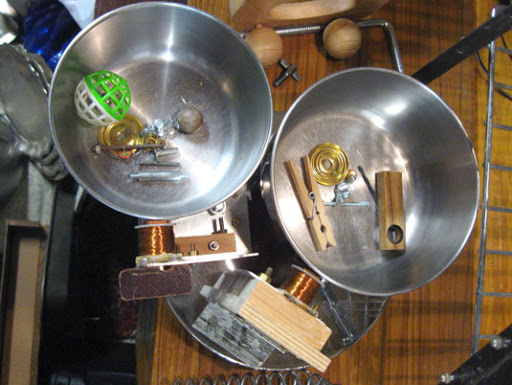
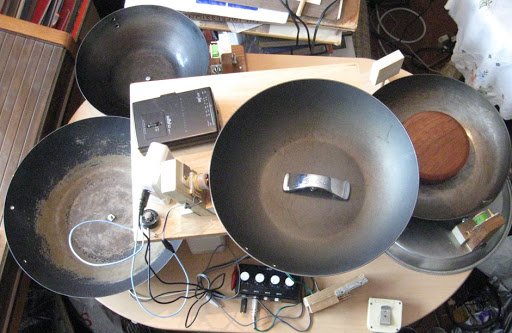
The standard stainless steel cooking bowls (un-wok-like), with a paucity of tone-ballast.

The cauldron is perhaps the paradigm of all this tone-drama-seeking malarkey.  In fact, it’s surprising that cauldrons aren’t used more often in improv gigs.  Objects may be placed in a vibrating cauldron and stirred until the much longed-for ‘tone-drama’ emerges.  The cauldron body would be resonated electromagnetically, and eventually, with enough stirring trials, there will arrive a point where a highly specific configuration is obtained, bringing about pulsing rhythms or harmonic progressions.

When I was angling to incorporate pseudo-cauldrons into resonant assemblies, the adage “beggars can’t be choosers” manifested itself in the galling fact that dishes and bowls receptive to magnetism are very hard to find.  If you walk into a shop, all the stainless steel bowls will be non-magnetic.  This is frustrating, as many of the most resonant bowls will not be suitable for resonating via the electromagnetic field method (a non-contact method of resonating).

Looking in bins and trade waste containers can yield older steel bowls, where the steel was treated differently during manufacture, thus retaining its ferric virtue and allowing for EM resonation.  Although, these are rare.

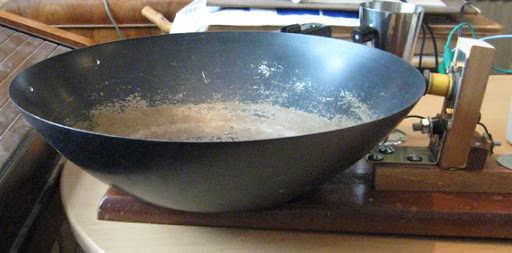
Wok mounted to a sounding board with resonator and pickup coils.

Whereas in the past the poverty and unemployability that necessitated my dumpster-diving actions lent a teeth-gnashing restrictive atmosphere, it’s now obvious that this impoverished flâneur approach embraces chance happenings: a good thing.  One day, a wok presented itself.  Woks can be easily adapted to resonate.  When a wok handle is removed, woks resound like Tibetan bowls…  And they’re always (in my experience) responsive to magnetism too.  Woks are also somewhat hard to find, but they’re easily spotted, at least, whether in bins, car-boot sales, or vistas of ruin.

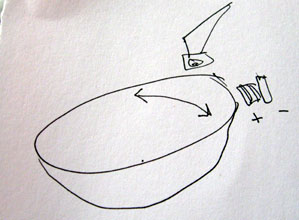
When a resonator coil is fixed in proximity to a wok’s rim, several harmonics can usually be obtained.  The most harmonically rich woks happen to be Ken Hom woks – this particular brand was the heaviest/densest I’ve so far found (the chrome handles of certain Ken Hom wok lids also make excellent subharmonic-generating objects to place inside woks).   The polarities and phase of the resonator coil / pickup coil combo can be arranged so that a descending scale of harmonics can be elicited by moving the pickup anticlockwise around the rim, on the right-hand side of the resonator (as shown in this scrawling).  When subharmonic ballast is added, a veritable sonic stir-fry is formed… with all the potency of the paradigmatic cauldron: thaumatacoustics in action.

So far, I have found four woks.  It is interesting to note that the resultant chords obtainable purely from the woks themselves – without adding objects inside – are chords of chance provided by the trade waste bins.   A convergence of people all deciding at a certain time to discard their woks resulted in this very specific chord.

I recorded a short and unpolished study simply to display aspects of this chord. (Please excuse the unskilful pickup collisions)….

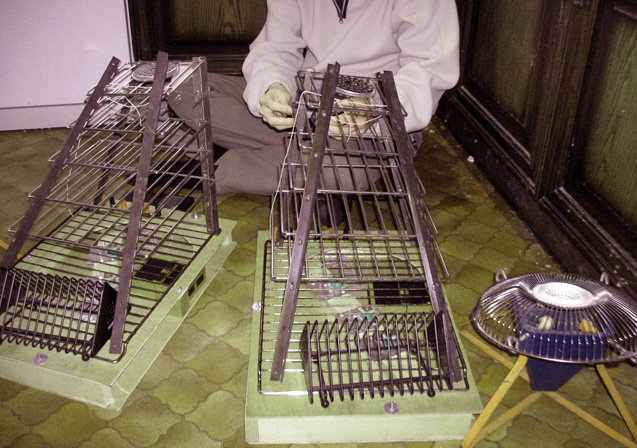
Build your own Francis Bacon ‘Sound-House’

I feel behaviourally aslant in my secret indulgence for dolls house paraphernalia.  But that’s mainly due to a culturally-instilled inhibition that really needs to be shaken off.  After all, dolls houses are affordable, but real houses are not.  As the saying goes, you must “live within your means”.

‘Rendering that scaffolding dangerous’

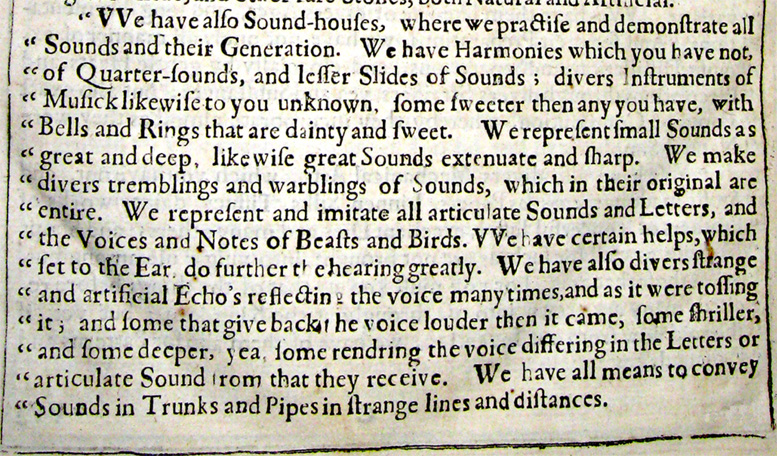
For some years now I’ve itched to create a Sound-House, as defined in Sir Francis Bacon’s unfinished fable ‘New Atlantis’ (1624):

“We have also sound-houses, where we practise and demonstrate all sounds and their generation.  We have harmonies which you have not, of quarter-sounds, and lesser slides of sounds; divers instruments of musick likewise to you unknown, some sweeter than any you have, with bells and rings that are dainty and sweet.  We represent small sounds as great and deep, likewise great sounds extenuate and sharp.  We make divers tremblings and warblings of sounds, which in their original are entire.  We represent and imitate all articulate sounds and letters, and the voices and notes of beasts and birds.  We have certain helps, which set to the ear, do further the hearing greatly.  We have also divers strange and artificial echos reflecting the voice many times, and as it were tossing it, and some that give back the voice louder than it came, some shriller, and some deeper, yea, some rendring the voice differing in the letters or articulate sound from that they receive.  We have all means to convey sounds in trunks and pipes in strange lines and distances.”

A previous posting (here) touched upon some visual clues as to how Francis Bacon may have designed his Sound House if he had been tasked with realising one.

The “we have also sound-houses” passage has come to be quoted as a foresightful envisioning of electronic sound treatments.  Yet the majority of modern electronic works invariably pivot on trickeries and deceptions of the ear – keeping the listener ‘in the dark’ as to the nature of sound sources and treatments.  (Also, Bacon’s words conjure to mind a mechanical acoustic endeavour with contrivances similar to those imagined by his inventor contemporaries Salomon de Caus or Cornelis Drebbel.)  Allying Bacon’s Sound Houses with electronic sound technique seems incongruous when Bacon later writes a few paragraphs later:

“And surely, you will easily believe that we that have so many things truly natural, which induce admiration, could in a world of particulars deceive the senses, if we would disguise those things, and labour to make them more miraculous: But we do hate all impostures and lies insomuch, as we have severely forbidden it to all our fellows, under pain of ignominy and fines, that they do not shew any natural work or thing adorned or swelling, but only pure as it is, and without all affectations of strangeness.”

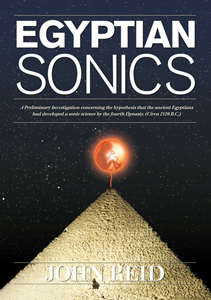
John Reid: Pyramid Sound-Houses?

If I ever had the opportunity to build a full size Baconian sound house, it would contain resonant granite sarcophagi (akin to those found in Egyptian tombs), moveable granite panelling and compartments.   Deep stone tunnels with mix-and-match obstructors.  Parallel surfaces for flutter echoes.  Bellow-pumped pipe tone generators and trumpeted alterants.   Clues may also be found in Bacon’s acoustical investigations documented in his Sylva Sylvarum.  In the meantime, I will continue experimenting with my dolls houses…  The dolls houses are more like weird garages, over-plumbed within an inch of their daintiness.  And the ‘dolls’ exist only in the mind.

Miraculous agitations in our acoustic environment – as I’ve written elsewhere – indicate the possibility of real-world sound rivalling electronic sound in terms of tonal complexity and delineation.  It is a question of engineering.  The miraculous agitation assemblies eventually come to resemble ‘houses’ – or ‘garages’ – stressed with the addition of perilously piled Jenga-like miscellany.  An ‘electromechnical Baconian dolls soundhouse garage’.   With all property so dismally unaffordable,  I would like to live in one of these… cohabiting with Cliff Richard’s proverbial ‘Living Doll’ – a husk of hope. (“Take a look at her hair, it’s real / And if you don’t believe what I say, just feel / I’m gonna lock her up in a trunk / So no big hunk can steal her away from me” [?!])